Pool deck resurfacing can be an excellent way to renew an aging Southwest Florida deck without tearing out otherwise serviceable concrete. But the finished color and texture are only the visible part of the job. The real decision starts underneath: Is the slab stable? What is already on it? Why did the old finish fail? How will the new system be prepared, bonded, textured, and maintained?
This guide is designed to help a homeowner evaluate those questions before choosing a contractor or product. It does not assume that one coating, overlay, or manufacturer is right for every deck.
The Short Version
- Resurfacing is best suited to concrete that is fundamentally stable. Decorative overlays can renew worn, stained, patched, or unattractive concrete, but they do not turn a moving or failing slab into a stable one.
- Preparation is part of the system, not a cleanup step. Existing coatings, contaminants, weak concrete, laitance, mildew, and incompatible materials can interfere with adhesion.
- The exact product system matters. “Acrylic,” “overlay,” “sealer,” and “cool deck” are not complete specifications.
- Southwest Florida weather changes the application problem. Heat, intense sun, high summer rainfall, moisture, and short weather windows all affect scheduling and product requirements.
- Wet traction and barefoot comfort should be designed together. More texture is not automatically better.
- A good proposal should name the products and preparation steps. If the bid only promises “resurface pool deck,” there is not enough information to compare it intelligently.
What Pool Deck Resurfacing Actually Means
“Resurfacing” is a broad term. At its simplest, it means preserving the existing deck structure while creating a new exposed surface. The new surface may be a thin coating system, a cementitious decorative overlay, a textured resurfacing system with a protective topcoat, or another compatible treatment designed for exterior concrete.
That is different from complete replacement, where some or all of the existing deck is demolished and rebuilt. It is also different from simply rolling another coat of paint over whatever is already there.
The distinction matters because the condition of the existing concrete remains part of the finished system. Sika, for example, describes its cementitious decorative overlays as products for resurfacing structurally sound, non-moving concrete. That is a useful principle even when another manufacturer is being considered: a new wearing surface can renew suitable concrete, but it cannot make an unstable substrate stable.
Step One: Decide Whether the Existing Deck Is a Good Candidate
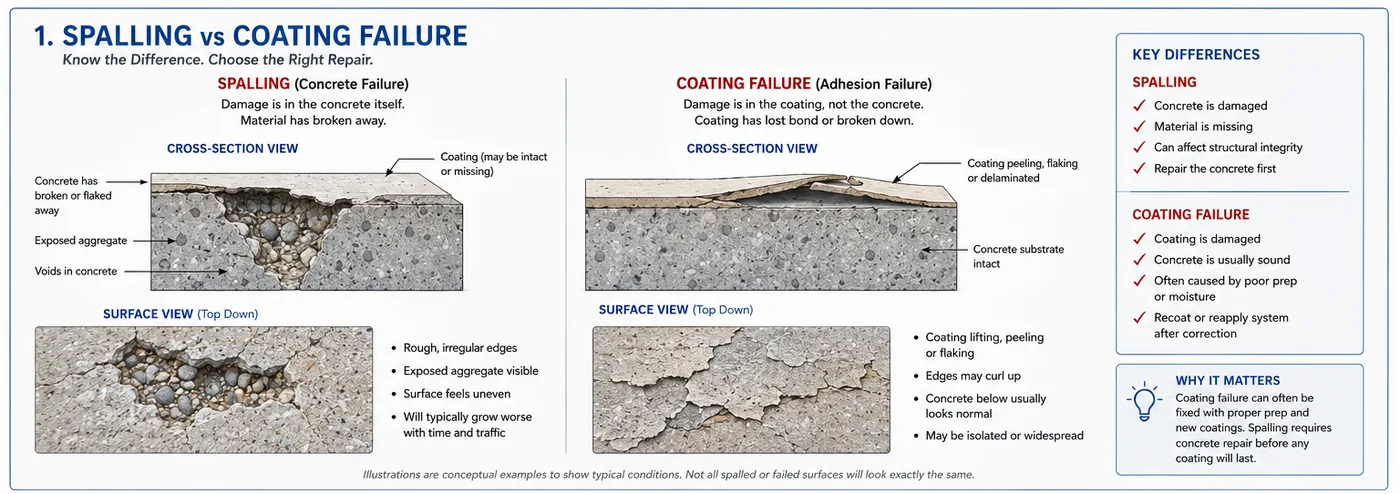
Before discussing colors, patterns, or finish names, inspect the slab itself. A deck does not have to be cosmetically perfect. Localized cracks, chips, small spalls, patches, discoloration, worn texture, and failed coatings may all be repairable. The more important question is whether the underlying concrete is sound enough to support the new system.
Warning signs deserve diagnosis before resurfacing: recurring displacement across cracks, sections that have settled or heaved, hollow or delaminated concrete, chronic standing water, badly deteriorated edges, or widespread failure that appears to originate in the slab rather than only in the coating.
A contractor recommending resurfacing should be able to explain why the deck is an acceptable substrate. If another contractor recommends replacement, that contractor should be able to explain what condition makes resurfacing a poor investment. The useful comparison is the reasoning behind the recommendations, not just the price difference.
Cracks Need to Be Classified, Not Just Hidden
Not every crack means the deck must be replaced, but not every crack should simply be filled and covered either. A static crack that has stopped moving presents a different problem from a joint or crack that continues to open, close, lift, or shift.
The reason is simple: movement in the substrate can reappear through the new surface. A repair may reduce the appearance of a crack and prepare it for a compatible system, but the contractor should not promise that every crack can be made permanently invisible.
For a deeper look at this decision, see Pool Deck Cracks: Repair, Resurface, or Replace?.
Surface Preparation Is Where Many Jobs Are Won or Lost
The International Concrete Repair Institute treats surface preparation as a technical selection problem. Its guidance starts with the condition of the substrate, the material that will be installed, and job-site conditions; then the preparation method and required concrete surface profile are selected to match the system.
In practical homeowner terms, the new material needs a surface that is clean, sound, appropriately roughened, and free of anything that interferes with bonding. Depending on the existing deck and the new system, that can involve mechanical grinding, blasting, pressure cleaning, removal of old coatings, patching, degreasing, treatment of mildew or contamination, and other manufacturer-specified preparation.
One reason generic bids are difficult to compare is that two contractors may both write “prep deck” while planning very different amounts of work. Ask what is being removed, how the surface will be profiled, how repairs will be handled, and what condition must exist before the first new layer is applied.
A Local Example: INSECO Floor & Deck H2O
INSECO Products in Fort Myers lists FLOOR & DECK H2O as a 100% acrylic coating for properly prepared concrete patios, walkways, pool decks, driveways, garage floors, and other surfaces. Its technical data emphasizes cleaning, dryness, removal of contaminants, adhesion testing, and creating sufficient texture on smooth-troweled concrete before coating.
The important lesson is not that this particular product should be used on every pool deck. It is that even a product sold specifically for pool-deck use comes with substrate and preparation requirements. A contractor who names the product lets the homeowner read those requirements and compare the proposed work with the manufacturer’s instructions.
Cementitious Resurfacing Systems Are a Different Category
A polymer-modified cementitious resurfacing system is not simply a thicker coat of paint. These systems can add a new textured wearing layer over properly prepared concrete and may then receive color or a protective topcoat.
Westcoat’s Texture-Crete is one current example. Westcoat describes it as a polymer-modified cementitious system installed over prepared concrete, commonly with a sprayed or knockdown texture and an acrylic topcoat. The manufacturer lists pool decks among its recommended uses and offers different finish options, including solar-reflective versions.
Sika likewise offers polymer-modified cementitious overlays intended for structurally sound exterior concrete. These examples show why the word “resurfacing” by itself is not enough: the homeowner should know whether the contractor is proposing a thin coating, a cementitious overlay, a multi-layer textured system, or something else.
Southwest Florida Makes Application Conditions Important
The Fort Myers 1991–2020 climate normals show an annual average of about 57 inches of rain, with roughly two-thirds of that rainfall arriving from June through September. Normal daily high temperatures are around 91°F during much of the summer. Those conditions do not make resurfacing impractical, but they make scheduling and moisture management part of the job.
Manufacturer limits vary. Some products require minimum or maximum surface temperatures, dry conditions, specific recoat windows, or protection from rain during curing. The contractor should be planning around the actual product data sheet rather than using one rule of thumb for every system.
This is particularly relevant when a deck is pressure washed shortly before coating, when afternoon storms are likely, or when a shaded or enclosed lanai stays damp longer than an exposed area. “It looks dry” is not always the same thing as “it meets the product’s application requirements.”
What About “Cool Deck”?
Homeowners often use “cool deck” as a generic description for a light-colored or textured pool-deck surface that is intended to be more comfortable in the sun. That language can create confusion because Kool Deck® is also a specific Mortex trademark and product family.
Surface Blueprint therefore uses the Mortex name only when discussing the actual branded product. When discussing heat performance more generally, we use terms such as cooler pool-deck surfaces, solar-reflective finishes, or the exact product/system name.
Heat performance should be evaluated by the specific finish, color, pigment technology, texture, exposure, and any published manufacturer data—not by assuming that every light or textured coating performs like every other one. See Cool Pool Deck Surfaces for Florida for a deeper comparison.
Wet Traction and Barefoot Comfort Are a Tradeoff
A pool deck needs useful wet traction, but making the surface extremely aggressive can make it uncomfortable on bare feet and harder to clean. Conversely, a smooth or glossy finish can become unpleasantly slick when wet.
Ask how traction is created: through the resurfacing texture itself, an aggregate or traction additive, the topcoat, or a combination. Then ask to see an actual finished installation if possible. A small decorative sample may not tell you how the complete system feels when wet and walked on barefoot.
See Slippery Pool Deck Solutions for more detail.
The Existing Coating May Be the Biggest Unknown
On an older Southwest Florida deck, there may already be several generations of coatings, sealers, patches, or unknown products. A new layer is only as secure as what it is bonded to. If an old coating is poorly adhered, coating over it can preserve the weak link rather than solve it.
This is why a peeling deck should be diagnosed rather than simply recoated. The contractor should determine whether the failure is localized or widespread, whether the old material is compatible with the proposed system, and how much of it must be removed.
For more on failure diagnosis, see Why Is My Pool Deck Coating Peeling?.
What a Good Resurfacing Proposal Should Tell You
A homeowner should be able to read the proposal and understand the system well enough to verify it. At minimum, ask for the following information:
- The condition the contractor believes the existing slab is in and any areas requiring repair.
- How cracks, spalls, hollow areas, old coatings, mildew, contamination, and other defects will be addressed.
- The surface-preparation method, not merely the word “prep.”
- The manufacturer and exact product names for primer, repair material, resurfacing/base layer, texture layer, coating, sealer, topcoat, and traction additive when applicable.
- The number of coats or layers and the intended finished texture.
- How color is produced and whether the finish is integral color, stain, pigmented coating, or another system.
- How wet traction is created.
- Application-weather limits and what happens if rain interrupts the work.
- Expected cure time before foot traffic, furniture, pool use around the deck, and cleaning.
- The contractor workmanship warranty and the manufacturer warranty, if any, with exclusions explained.
- How the surface should be cleaned and maintained, and what future recoating normally involves.
Red Flags in a Pool Deck Resurfacing Bid
Be cautious when the proposal is built almost entirely around color and price while saying little about the existing surface. Other warning signs include refusing to identify products, promising that all cracks will disappear permanently, treating every old coating as suitable to coat over, describing pressure washing as the complete preparation plan without reference to the proposed system, or using a proprietary-sounding finish name without explaining what materials are actually being installed.
Another red flag is an estimate that cannot explain why the proposed system is appropriate for your deck. A product may be excellent and still be wrong for a particular substrate, previous coating, drainage condition, or desired finish.
Resurface or Replace?
When the slab is stable and the problems are primarily surface-related, resurfacing can avoid much of the demolition and reconstruction involved in replacement. When the underlying deck is moving, badly deteriorated, poorly drained, or otherwise unsuitable, a cosmetic surface may only postpone the larger repair.
The decision should therefore be based on the condition of the substrate and the scope required to correct it—not on the assumption that resurfacing is always cheaper or replacement is always better. See Pool Deck Resurfacing vs. Replacement for the full comparison.
How Surface Blueprint Evaluates Resurfacing Systems
Surface Blueprint does not sell or install coatings. We compare systems by the substrate they require, preparation, compatibility, climate exposure, wet traction, heat performance, maintenance, repairability, published technical data, and contractor execution.
Manufacturer examples in this guide are illustrative rather than exclusive recommendations. As we add contractor interviews, local installations, failure examples, pricing observations, and manufacturer technical input, this guide will be updated so homeowners can compare real Southwest Florida experience with published product requirements.
Technical Sources and Further Reading
- International Concrete Repair Institute: Selecting and Specifying Concrete Surface Preparation
- ICRI Guideline 310.2R-2013
- Sika: Decorative Concrete Overlays
- INSECO: FLOOR & DECK H2O
- INSECO: FLOOR & DECK H2O Technical Data
- Westcoat: 2026 Texture-Crete Concrete Resurfacing Systems
- Florida Climate Center: Fort Myers 1991–2020 Climate Normals
- Mortex: Kool Deck® Consumer Information and Trademark Notice