
Old Chattahoochee or epoxy-bonded river-rock decks are still common around Florida homes. The important question is not whether the surface is “old.” It is whether the stone and binder are still sound enough for maintenance, have localized failures that can reasonably be repaired, are suitable for an overlay, or have deteriorated far enough that removal makes more sense.
Quick answer
Do not assume loose river rock automatically means complete removal—and do not assume a fresh clear sealer will repair a failing deck. Current product instructions and Florida contractors describe several different scopes: cleaning/resealing sound stone, repairing localized loose areas, resurfacing over a sufficiently sound existing surface, installing another hardscape system over a stable base, or removing the river-rock layer when deterioration is too widespread. An on-site condition assessment determines which category applies.
What is Chattahoochee stone?
Epoxy-bonded stone surfacing combines small decorative aggregate—often rounded river rock—with a resin binder and installs the mixture as a topping over concrete. An industry history published by Concrete Decor describes epoxy-bonded stone as becoming popular in North America in the 1970s and notes that “Chattahoochee stone” became a familiar name for river-rock surfacing in Florida.
The open texture can allow water to pass through the stone layer, which helped make it attractive around pools and patios. But a porous topping does not make drainage irrelevant. Water still has to go somewhere after it passes through or across the surface, and the condition, slope, joints, cracks, and drainage of the concrete beneath remain important.
Why some old decks last and others start shedding pebbles
There is no honest single service-life number for old river-rock decking. Current installers and maintenance specialists consistently point to the condition of the epoxy binder, exposure, cleaning and resealing history, and the underlying concrete. Allums Chattahoochee Riverrock says resealing frequency depends in part on sun and other exposure. J&J Chattahoochee Stone describes cleaning and resealing as maintenance as the epoxy wears.
That makes “maintenance-free” a poor way to think about the system. A deck can remain attractive and serviceable for many years, but the binder and protective finish are exterior materials exposed to Florida sun, rain, heat and wet/dry cycling.
A reseal and a repair are not the same job
This is one of the most important distinctions we found. Richard’s Paint sells a Chattahoochee/River Rock sealer intended to protect and restore properly prepared stone. Its published product data sheet specifically requires epoxy-set stone to be checked for deterioration or crumbling and states that the sealer will not correct weak surface areas, moisture intrusion, or re-bond loose stone.
Other specialty epoxy suppliers describe a two-step approach when stones are already loose: first pick up and reinstall or re-bond the failed areas with a repair resin, then re-glaze or reseal the sound field. In other words, the words reseal, re-epoxy, repair, and reglaze can describe materially different work. Ask exactly what product is being used and what it is expected to accomplish.
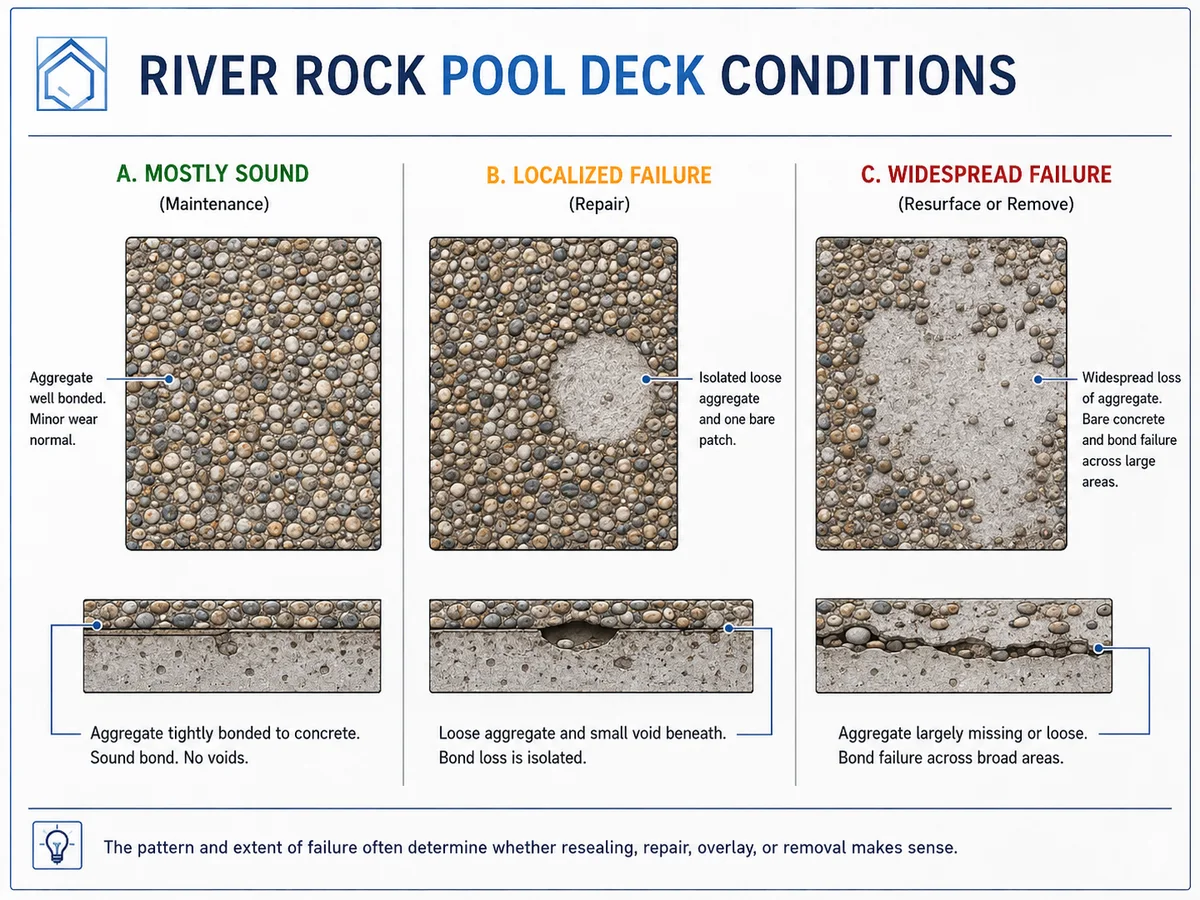
Four condition categories
1. Sound stone that mainly looks dry, dull or weathered
If the aggregate and binder remain sound and firmly attached, cleaning and an appropriate maintenance coating or reglaze may be a reasonable scope. The exact product matters: some are single-component clear finishes; other maintenance systems use reactive epoxy chemistry.
2. Localized loose areas with sound material around them
Localized repair may be possible. Specialty suppliers and contractors still advertise river-rock repair products and repair services. The key question is whether the perimeter of the repair reaches material that is genuinely sound. Filling the visible bare spot while bonding the patch to marginal surrounding material can simply leave the next weak area at the edge of the new repair.
3. A generally stable deck that you want to cover or modernize
Some Florida resurfacing contractors report installing decorative overlays over Chattahoochee after inspection when the existing surface is sufficiently sound. Other hardscape systems also publish methods for installation over stable exposed-aggregate surfaces. That does not mean every old river-rock deck is an acceptable substrate. The new system is still relying on what remains beneath it.
4. Widespread loose stone, weak binder, moisture or substrate problems
Once deterioration is widespread, another clear coat is not a substitute for removing weak material. Removal can also become attractive when the project needs access to cracks, failed concrete, drainage problems, plumbing, or other conditions hidden beneath the topping. The decision should be based on the condition of the system—not simply on the age of the house.
The visible bare patch may not be the full repair area
With bonded toppings, the edge of visible failure is not necessarily the edge of weak material. A competent repair assessment should determine whether the aggregate immediately around a failed spot is still firmly bonded. If scraping or probing one loose area repeatedly exposes more marginal material, the scope can grow from a patch into a larger restoration decision.
This is the same substrate-first principle that applies to ordinary coatings: a new repair can only remain attached as well as the material it is actually bonded to.
Drainage deserves its own inspection
River-rock surfacing is often described as porous or draining because water can pass through spaces within the aggregate layer. That feature does not correct a low concrete slab, blocked discharge path, failed joint, or water trapped where it should not be. If deterioration is concentrated near low spots, drains, screen-enclosure edges, planters, or places that stay damp, the drainage condition should be investigated rather than simply coated over.
What to ask a contractor before agreeing to repair or reseal
- Is the proposed job maintenance, localized repair, re-epoxying/reglazing, resurfacing over the stone, or removal?
- How will you determine whether the stone around failed areas is sound enough to keep?
- What exact product will re-bond loose aggregate, and what exact product will be used over the rest of the deck?
- How dry must the deck be before the resin or sealer is applied?
- What happens if additional weak areas are found after preparation begins?
- How will existing cracks, joints, low spots and drainage paths be handled?
- If an overlay will remain over the old river rock, what manufacturer documentation supports that substrate and preparation method?
- Can you show older local repairs or resurfacing projects—not only photographs taken immediately after completion?
What does river-rock repair cost?
Surface Blueprint did not find a sufficiently reliable current Florida dataset to publish a meaningful per-square-foot range for Chattahoochee repair or resealing. The job can range from cleaning and maintenance to localized reconstruction, overlay, or demolition, so quoting one statewide number would create false precision.
We are collecting recent Florida quotes and completed-project costs so this can eventually be replaced with homeowner-reported data.
Help build the Florida river-rock dataset
If you have recently repaired, resealed, resurfaced, covered, or removed a Chattahoochee/river-rock deck, email contact@surfaceblueprint.com. Useful details include Florida county, approximate square footage, what condition the deck was in, what work was proposed, quoted/final price, year completed, and photos if available. Remove addresses, account numbers, or anything else you do not want shared.
Florida contractors: Surface Blueprint is also interviewing contractors with documented experience maintaining and repairing old Chattahoochee systems. We are particularly interested in how you decide whether a deck should be maintained, locally repaired, overlaid, or removed.
The practical takeaway
An old river-rock deck should not be sentenced to demolition just because a few stones are loose, and it should not be sold a cosmetic reseal if the substrate is already failing. The useful sequence is identify the system → determine what is actually loose or weak → check moisture/drainage and the concrete beneath → define whether the scope is maintenance, repair, overlay or removal → then price that scope.
For broader decisions, see Pool Deck Resurfacing, Resurfacing vs. Replacement, Surface Preparation, and Pool Deck Resurfacing Cost.
Sources and further reading
- Concrete Decor: “Get the Rock Look With Epoxy-Bonded Stone Systems”
- Richard’s Paint: Shield’s All Chattahoochee Epoxy Sealer product data sheet
- Epoxy.com: Epoxy Stone Maintenance
- Allums Chattahoochee Riverrock: installation and reseal services
- J&J Chattahoochee Stone: maintenance/reseal description
- Palm Beach Resurfacing: Chattahoochee inspection and resurfacing FAQ
- Charlotte County Chamber: Flex-Path / Pool Deck Lady river-rock services
Optional project check
Repair, reseal, resurface or remove? Check your situation.
Answer a few questions and we will show what the condition suggests before asking for your name, email or phone number. This is not a diagnosis or contractor quote.