Cracks in a concrete pool deck do not automatically mean the deck needs to be replaced. Concrete commonly develops cracks for several reasons, including shrinkage, temperature changes, restraint, settlement, and movement between sections. What matters is why the crack formed, whether it is still moving, and what condition the surrounding concrete is in.
Before choosing a coating or resurfacing system, the cracks should therefore be evaluated as part of the existing deck.
Which Pool Deck Crack Repair Fits Your Situation?
Start with the condition of the concrete, not the name of a filler. This quick guide helps you identify the next step; it is not a substitute for inspecting a slab that is moving or deteriorating.
| What you see | Usual next step | What to watch for |
|---|---|---|
| Fine hairline crack; both sides level; no apparent change | Check whether it is stable, clean and sound. A compatible crack treatment may be included before coating or resurfacing. | Some thin cracks need special preparation for a repair product to penetrate or bond. |
| Wider crack but both sides level | Determine whether movement is expected, then choose an appropriately specified sealant, resin or repair mortar. | Width alone does not prove the crack is structural or dormant. |
| Crack reopens after repair or changes over time | Investigate movement and moisture before another surface repair. | A rigid patch can fail again if the slab continues moving. |
| One side higher, slab sinking, or multiple displaced sections | Have the underlying settlement, heaving or support condition evaluated before resurfacing. | Trip hazards and drainage problems cannot be solved simply by filling the crack. |
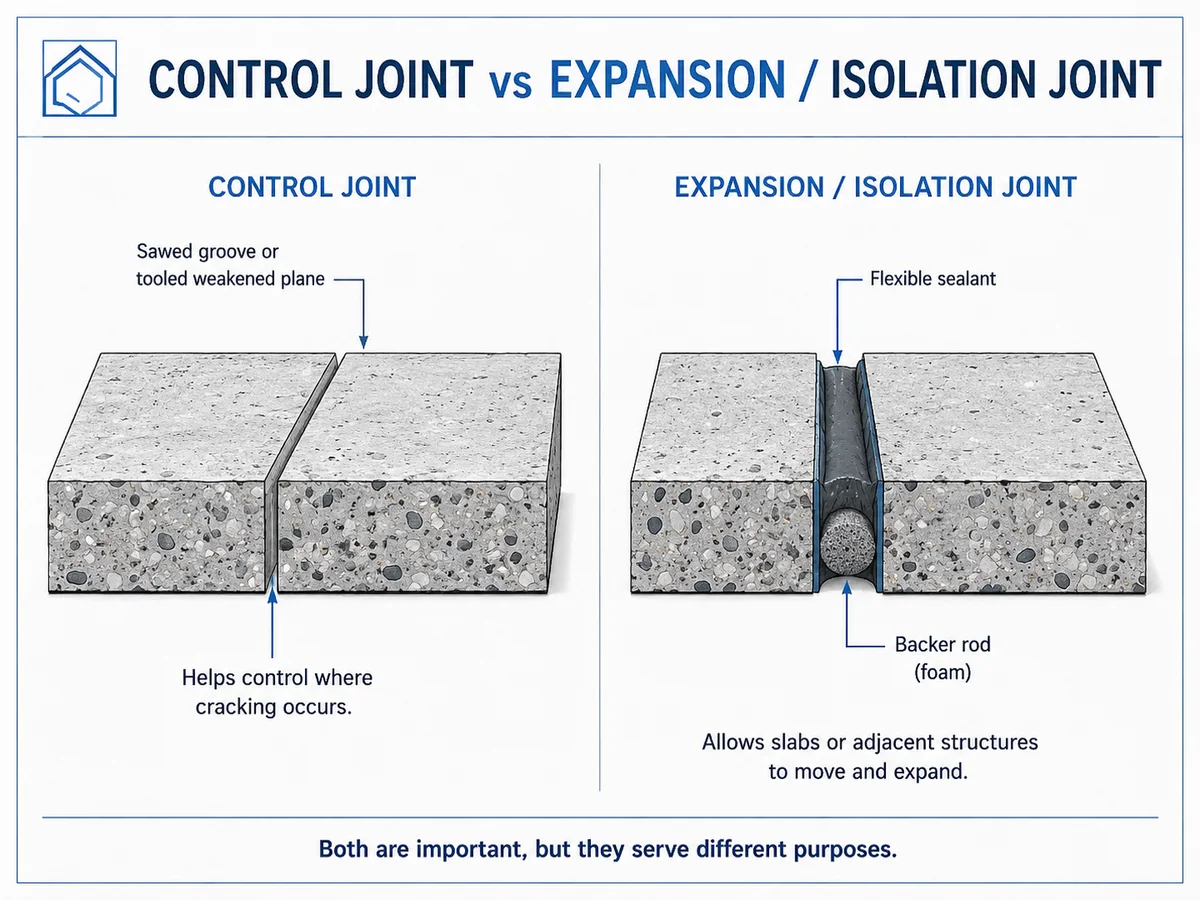
| Straight, deliberate line at a joint or transition | Identify whether it is a control, expansion or isolation joint and preserve its intended function. | Do not bridge a movement joint with a rigid decorative patch. |
| Crack with loose, hollow or crumbling concrete | Remove or assess unsound material and determine the extent of deterioration before selecting a patch. | New coating will not restore an unsound substrate. |
Before paying for a repair: ask the contractor to identify the crack type, explain whether it is moving, name the proposed repair material and confirm its compatibility with the final pool-deck finish. Even a correctly filled crack may remain visible after recoating because texture and color matching are separate challenges. See our pool deck patching and texture-matching guide for those practical limitations.
Why Do Pool Decks Crack?
Concrete changes dimension as it cures and as environmental conditions change. Drying shrinkage occurs as concrete loses moisture, while temperature changes and restraint can create additional stresses.
Pool decks also contain different sections, joints, coping, drains, screen-enclosure supports, and other transitions that can influence where movement occurs.
Some cracking may be relatively minor and stable. Other cracks can indicate continuing movement that deserves more attention before the deck is resurfaced.
Hairline Cracks
Very narrow cracks are common in exterior concrete and may result from shrinkage or other normal movement.
A hairline crack by itself does not establish that the slab has a serious problem.
The more useful questions are:
- Has the crack changed noticeably over time?
- Are the two sides still at the same elevation?
- Does water regularly enter through it?
- Are similar cracks appearing elsewhere?
- Is the surrounding concrete solid?
- Has a previous repair cracked again?
A stable hairline crack may be handled as part of a resurfacing project, depending on the resurfacing system and manufacturer’s requirements.
When Is a Pool Deck Crack More Concerning?
Width alone does not tell the complete story.
A crack deserves closer evaluation when there is:
- Vertical displacement between the two sides
- Noticeable settlement or heaving
- A crack that continues to widen
- Repeated failure of previous repairs
- Several cracks associated with a sunken or raised section
- Loose, hollow, or deteriorated concrete nearby
- Water or drainage problems concentrated around the crack
A crack accompanied by movement in the slab is fundamentally different from a stable surface crack.
What Is an Active Crack?
For resurfacing purposes, one of the most important distinctions is whether a crack is dormant or continues to move.
A repair material can fill or seal a crack, but that does not necessarily eliminate the forces that created it. Different repair materials and methods are appropriate depending on whether continued movement is expected.
This is why a contractor should not automatically treat every crack with the same rigid patching material.
Ask:
“Do you believe this crack is still moving, and how does the proposed repair accommodate that movement?”
How Cracked Pool Deck Repair Is Actually Planned
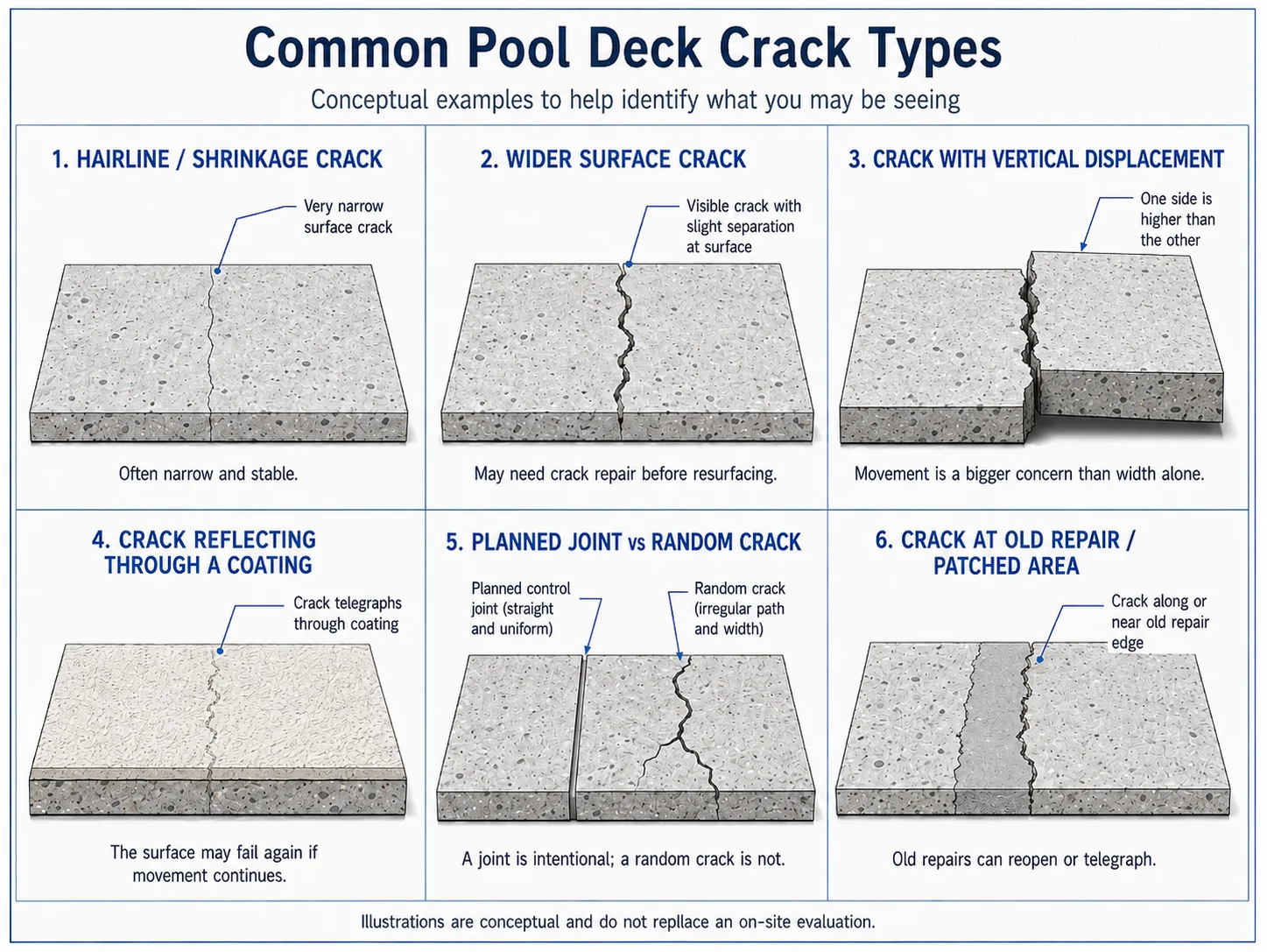
There is no single “pool deck crack repair” that is correct for every crack. A stable hairline crack, a moving crack, a failed old repair, an intentional joint, and a crack with vertical displacement are different conditions even when they look similar in a photo.
A practical repair sequence is:
- Identify what the line is. Confirm whether it is a random crack, a control joint, an expansion/isolation joint, or the edge of an earlier repair.
- Check for movement and displacement. If one side is higher, the crack is widening, or repairs repeatedly fail, determine why the slab is moving before treating the surface.
- Remove unsound material and contamination. Loose concrete, dirt, failed filler, coating residue and other bond-breaking material must be dealt with before a repair product can bond properly.
- Select a repair method that matches the condition. Flexible sealants, low-viscosity resins, rigid patching materials and other repair products serve different purposes. The repair also has to be compatible with the coating or resurfacing system that will follow.
- Preserve intentional movement joints. A control or expansion joint should not automatically be turned into a rigid patch just because a decorative coating will be installed over the deck.
- Finish the repair as part of the resurfacing system. Profile, cure time, primer, reinforcement, texture and overcoat requirements should come from the repair-product and resurfacing-system instructions—not from a generic “fill the crack” rule.
What Material Is Used to Repair Pool Deck Cracks?
The answer depends on whether the crack is expected to move and what will be installed over it. Manufacturer guidance illustrates why the choice matters. QUIKRETE, for example, publishes both flexible crack/joint sealants and more rigid concrete-repair products, and its instructions distinguish moving joints from ordinary crack filling. Sika also publishes low-viscosity epoxy products intended to penetrate and bond cracks in concrete. Those are different repair strategies, not interchangeable versions of the same material.
For an exposed concrete crack that is intended to remain flexible, a sealant may be appropriate. For a dormant crack that needs bonding or filling, a resin or patching product may be considered. For a crack that continues to move, simply installing a rigid filler can set up another visible failure. And when the deck will be coated or resurfaced, the repair must also be acceptable under that specific finish system.
Important: product instructions vary. Some crack-repair products require the crack to be opened or routed, some use backer rod at specified widths or depths, and some are not intended for structural repairs or movement joints. Follow the current technical data for the exact product being used.
Can You DIY a Pool Deck Crack Repair?
A stable, non-displaced crack in otherwise sound concrete can be within the ability of a careful DIY homeowner, particularly when the repair product has clear instructions and the deck is not immediately being covered by a complex resurfacing system.
The job becomes less forgiving when the crack is moving, one side is higher, the deck has several failing repairs, the concrete sounds hollow or deteriorated, drainage is involved, or a decorative overlay must hide the repair without telegraphing it later. In those situations the hard part is usually diagnosis and system compatibility rather than squeezing material into the crack.
What a Proper Repair Does—and Does Not—Do
A good crack repair can seal an opening, restore continuity in appropriate dormant cracks, accommodate limited movement when a flexible system is used, and create a suitable surface for the next coating or overlay. It does not automatically correct settlement, heaving, poor drainage, unstable base material, or continuing slab movement.
That distinction is why the visible repair should not be the first decision. The first decision is whether the concrete is stable enough to be worth repairing and resurfacing.
Manufacturer references: QUIKRETE — Repairing & Sealing Cracks in Concrete; QUIKRETE — Advanced Self-Leveling Sealant; Sika — Sikadur Crack Fix.
Can Pool Deck Cracks Be Repaired Before Resurfacing?
Often, yes.
Different repair materials are available for different types of cracking, including flexible sealants, low-viscosity resins, patching materials, and other concrete-repair products.
The appropriate method depends on such factors as:
- Crack width
- Crack depth
- Whether movement is expected
- Condition of the surrounding concrete
- Moisture
- The resurfacing system that will be installed afterward
The crack repair and the resurfacing system should be compatible with one another.
Will Resurfacing Hide Pool Deck Cracks?
It can hide repaired cracks visually, but that does not guarantee that they will never become visible again.
If movement continues in the underlying concrete, an existing crack can eventually reappear through a resurfaced surface.
That makes the cause of the cracking more important than simply covering it.
A resurfacing system can create a uniform new appearance over properly prepared concrete, but it should not be expected to permanently conceal continuing slab movement.
What About Expansion and Control Joints?
A joint is not necessarily a defect.
Concrete slabs intentionally use joints to accommodate movement and influence where cracking occurs. Expansion joints provide room for concrete sections to expand and contract rather than forcing that movement into uncontrolled cracking.
A resurfacing contractor should understand which lines in the deck are intentional joints and how the proposed system handles them.
Simply filling every visible line and coating over it can defeat the purpose of a movement joint.
Ask:
“Which of these are cracks and which are intentional joints, and how will each be treated?”
Can You Just Fill the Cracks and Paint the Pool Deck?
Sometimes a relatively simple repair and coating may be appropriate, but the sequence should still begin with determining what caused the cracks.
Filling a crack makes it look repaired. It does not necessarily make the slab stable.
Before recoating, consider:
- Whether the crack is stable.
- Whether the surrounding concrete is sound.
- Whether moisture is involved.
- Whether an intentional joint is being mistaken for a crack.
- Whether the repair material is compatible with the new coating.
- Whether the resurfacing system can tolerate the expected movement.
The type of coating matters too; see our Pool Deck Coatings guide for a comparison of the major systems.
A previous repair that has cracked again is particularly useful evidence because it suggests the underlying movement may not have stopped.
Cracks With Vertical Displacement
A crack where one side is noticeably higher than the other deserves more attention than a narrow crack whose two sides remain level.
Vertical displacement can indicate movement of the slab sections rather than simple surface shrinkage.
That can create several problems around a pool:
- A trip hazard
- Poor drainage
- An uneven finished surface
- Continued movement through a new coating or overlay
Grinding down a raised edge may reduce a trip hazard in some situations, but it does not explain why the sections moved.
Before investing in decorative resurfacing, determine whether the movement is stable and whether the underlying condition requires correction.
When Can a Cracked Pool Deck Still Be Resurfaced?
A cracked deck may still be a good candidate for pool deck resurfacing when the underlying concrete remains sound and stable and the cracks can be appropriately treated.
Resurfacing is not intended to turn unstable concrete into stable concrete. Continued movement in the original slab can cause cracks to reappear through a new surface.
This means an older deck can look quite rough and still potentially be resurfaced successfully if its problems are primarily superficial.
Conversely, a relatively attractive deck can be a poor resurfacing candidate if sections continue to move.
When Should Replacement Be Considered?
Replacement deserves consideration when problems extend substantially beyond the exposed surface.
Examples can include:
- Extensive settlement or heaving
- Numerous significantly displaced sections
- Widespread deteriorated concrete
- Continuing movement
- Major drainage or elevation problems
- Extensive failed repairs
- A need to substantially redesign the deck
Replacement is a larger project, but repeatedly repairing or coating an unsuitable slab can become a false economy.
For more information about project pricing, see our Pool Deck Resurfacing Cost guide.
The contractor recommending resurfacing should be able to explain why the existing concrete is a suitable base for the proposed system.
What Should a Contractor Tell You About Your Cracks?
Before accepting a resurfacing proposal, ask:
- What do you believe caused these cracks?
- Which cracks appear stable?
- Do any appear to be moving?
- Are any of these lines intentional joints?
- Is there vertical displacement?
- How will each type of crack be repaired?
- What repair material will be used?
- Is it compatible with the resurfacing system?
- What happens if the crack reappears?
- Does the warranty cover cracking or only coating adhesion?
- Do any sections of the slab need additional evaluation before resurfacing?
If the existing surface is also peeling or delaminating, see Why Is My Pool Deck Coating Peeling?
A contractor who evaluates the cracks individually is giving you more useful information than one who simply says:
“We fill all the cracks before we coat it.”
Repair, Resurface, or Replace?
The visible crack is only part of the decision.
A better sequence is:
Identify the crack → determine whether movement is continuing → evaluate the surrounding concrete → select the appropriate repair → then decide whether resurfacing makes sense.
For many homeowners, the answer will still be resurfacing. But understanding the cracks first reduces the risk of spending several thousand dollars on a new finish that simply reproduces the old problems.
Surface Blueprint starts with the condition of the existing surface because the best-looking resurfacing system cannot correct an underlying slab that is still moving.