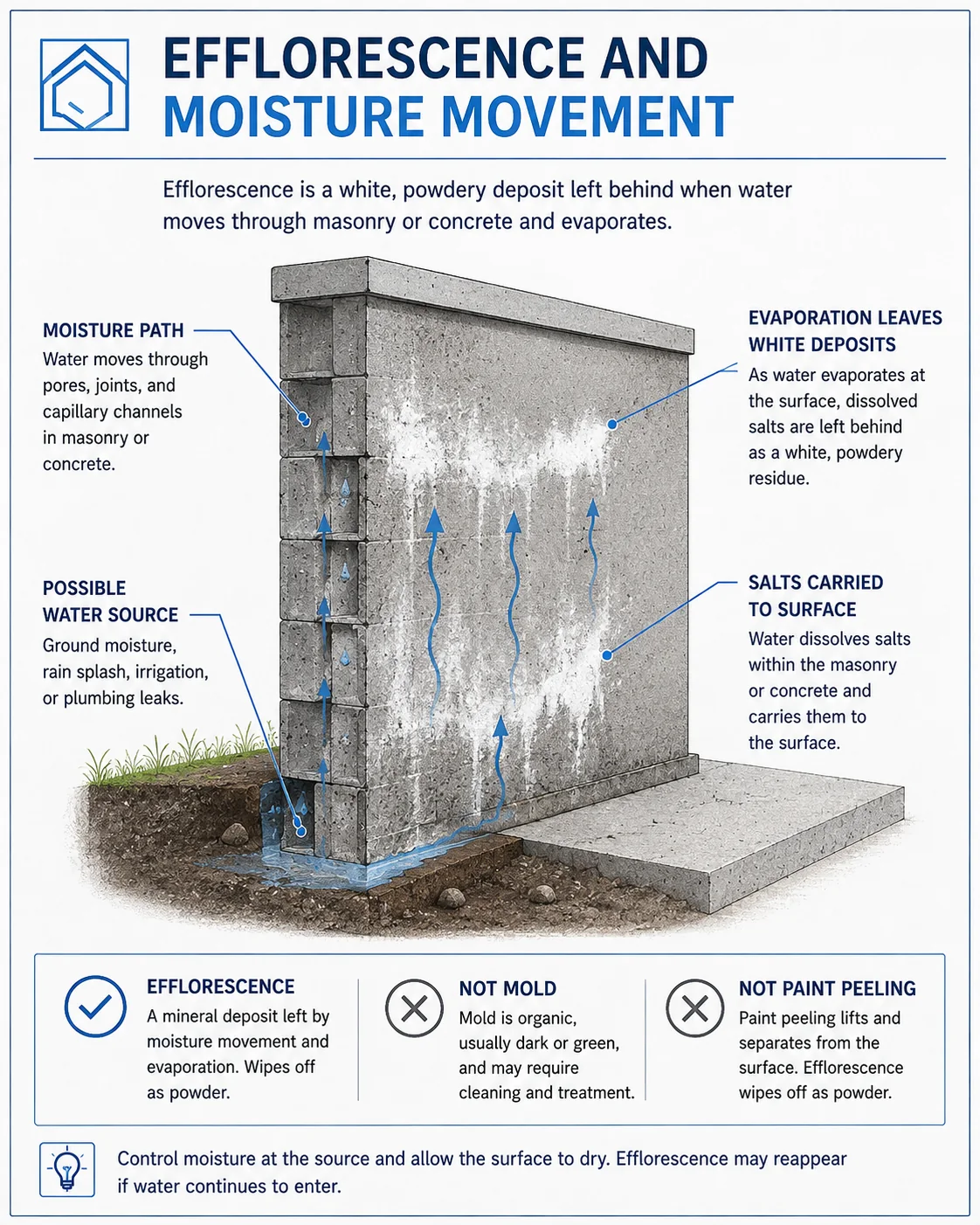
White crystalline deposits on masonry are often efflorescence; black, green or brown surface growth may be mold, mildew or algae. They can occur on the same wet surface, but they are not the same problem. Efflorescence is mineral salt left behind as water evaporates. Mold is biological growth sustained by moisture and an available food source.
What Efflorescence Looks Like
Efflorescence commonly appears as a white, powdery or crystalline deposit on concrete, stucco, brick or pavers. Water dissolves soluble salts within or behind masonry, carries them toward the surface, and leaves the salts behind as it evaporates. Recurring efflorescence is therefore evidence that moisture is moving through the material even though the deposit itself is not mold.
What Mold or Mildew Means
EPA guidance emphasizes that mold control is moisture control. On hard surfaces, visible mold can often be scrubbed with detergent and water and then dried completely, but recurring growth means the moisture condition also has to be corrected.
Why Color Alone Is Not Enough
Not every white deposit is efflorescence and not every dark stain is active mold. Dirt, atmospheric staining, old coating chalk, mineral scale and algae can resemble one another. Texture, location, recurrence after wetting and simple cleaning observations are useful clues.
Before Painting or Sealing
Do not simply encapsulate unexplained deposits. EPA specifically advises against painting or caulking moldy surfaces before cleaning and drying them. Efflorescence likewise should trigger a moisture/source check before a new film-forming coating is installed.
Florida Practical Rule
If the deposit keeps returning in the same place, treat recurrence as diagnostic information. On stucco, look for cracks, openings, roof/wall transitions and wall-system moisture. On pavers and slabs, consider drainage, irrigation, joint/base moisture and moisture moving through the concrete.