
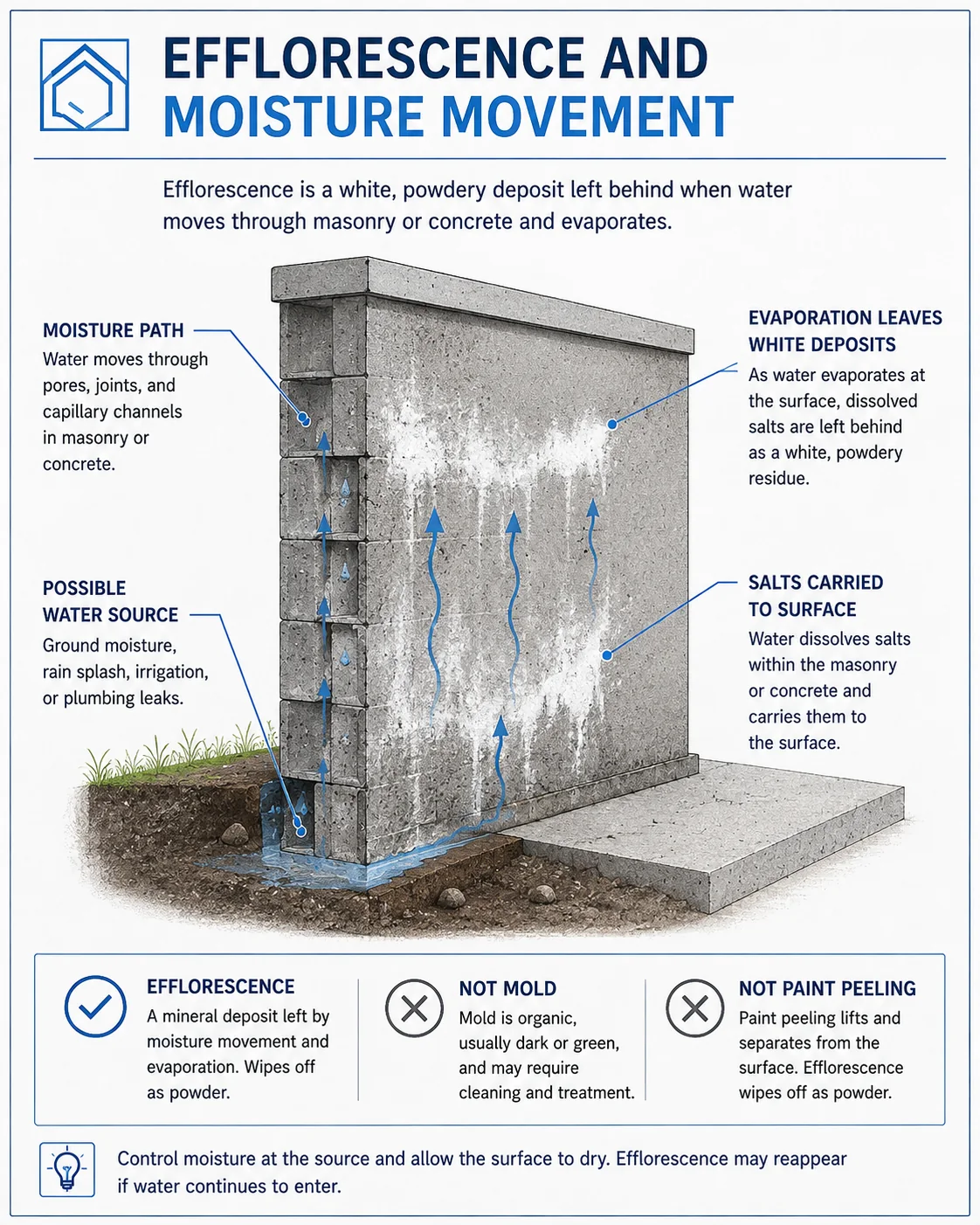
White powder or crystalline bloom on stucco is often called “chalk,” but if the material is mineral salt coming out of the cementitious surface, it is efflorescence. Painting over it without understanding why it formed can trap the symptom under a new film while the moisture-and-salt cycle continues.
Quick Answer
Remove loose efflorescence and determine whether the wall is still being wetted before coating. New stucco can show primary efflorescence during curing. Older stucco can show secondary efflorescence when water enters the cementitious surface, dissolves salts, and later carries them outward as it evaporates. Repeated deposits deserve a moisture-path investigation.
Efflorescence vs. Paint Chalking
| Condition | Where the powder comes from | What it suggests |
|---|---|---|
| Paint chalking | Weathering/degradation of the paint film. | Surface preparation and coating condition problem. |
| Efflorescence | Soluble mineral salts carried by moisture through cementitious material. | Moisture movement through or into the stucco/concrete/masonry. |
| Masonry dusting | Weak or friable cementitious surface. | Substrate condition problem that may require conditioning or repair. |
Primary Efflorescence on New Stucco
The Stucco Manufacturers Association describes primary efflorescence as something that can occur during initial cement curing when excess water moves to the surface. Damp or cool curing conditions can make it more noticeable. A new wall should not simply be sealed under paint until the coating system’s cure, pH, and preparation requirements are met.
Secondary Efflorescence on Existing Stucco
SMA explains that cured cement plaster can develop secondary efflorescence when water penetrates the cementitious material, dissolves salts, and later evaporates toward the surface. Hairline cracks are common collection points because rainwater running down the wall can enter the crack and sit there.
This is an important nuance: mineral bloom along a hairline crack does not automatically prove water is leaking from behind the stucco. Face-applied rainwater can be enough. But repeated or widespread deposits still tell you that water is moving through the material somewhere.
Why Dark Stucco Colors Can Make It More Obvious
SMA cautions that dark-colored walls can make the whitish deposit much more visible and may increase evaporation-driven salt movement because the surface becomes hotter in the sun. In Florida, that combination of rain followed by strong sun can make the effect especially noticeable.
Do Not Confuse Efflorescence Resistance With Fixing the Water Source
Some masonry primers and coatings advertise resistance to alkali and efflorescence. That can improve coating performance on an appropriate surface. It does not mean the coating can safely ignore a leaking window, failed flashing, chronic wetting, or a wall that is not drying.
Before You Paint
- Confirm whether the white material is paint chalk, mineral efflorescence, or something else.
- Brush or clean loose deposits using a method compatible with the stucco and coating manufacturer.
- Look for recurring cracks, irrigation spray, roof runoff, missing sealant, failed flashings, and other wetting sources.
- Allow the wall to dry to the limits required by the coating system.
- Use the specified alkali-resistant primer/conditioner when required.
- If deposits repeatedly return, solve the moisture path rather than applying successive coats over the symptom.
Related Problem: Chalk After Pressure Washing
If the powder is coming from old paint rather than mineral salts, see Florida Stucco Still Chalky After Pressure Washing. The preparation strategy is different.