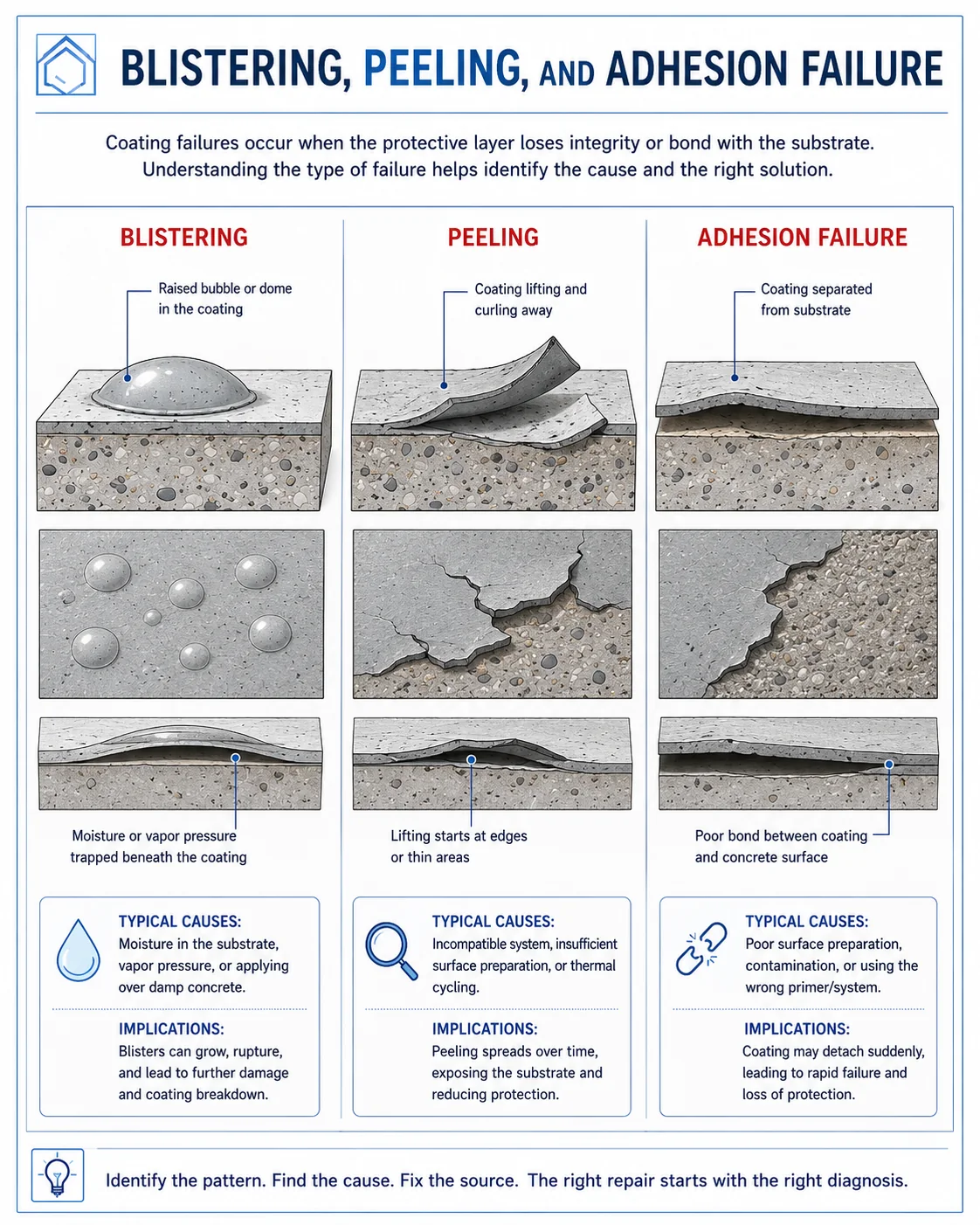
Concrete can look dry while still moving moisture vapor. When a relatively impermeable coating is installed over a slab with excessive moisture or soluble salts, the bond line can become the weak link. Bubbles, blisters, craters and delamination are classic symptoms that deserve a moisture investigation before the surface is recoated.
Where the Moisture Comes From
Concrete contains water from its original mix and remains porous after curing. Moisture can also enter from rain, irrigation, a high water table, poor drainage or a missing/damaged vapor retarder. Exterior Florida slabs add repeated wetting and high humidity to the equation.
Why the Coating Fails
Laticrete notes that moisture trapped under a coating can contribute to bubbling, craters and delamination. Sherwin-Williams flooring guidance similarly describes moisture movement and soluble salts as mechanisms that can degrade the bond line and produce bubbles, blisters or delamination.
A Surface Meter Is Not a Final Slab Test
Handheld moisture meters are useful for screening, but they generally sample near the surface and can be influenced by concrete composition. For decisions involving moisture-sensitive floor systems, in-situ relative-humidity testing is a more appropriate method because it measures conditions within the slab.
Exterior Driveways and Pool Decks
Exterior concrete coatings are not identical to interior flooring systems, and manufacturers may specify different moisture tolerances. The practical lesson is the same: do not assume a sunny afternoon proves the slab is ready. Follow the exact product’s moisture, drying, primer and weather requirements.
Before Recoating a Failed Area
Removing the blistered film without identifying why it lifted can simply reset the clock on the same failure.
- Check drainage and irrigation around the slab.
- Look for efflorescence or salts at failure areas.
- Determine what coating is already present.
- Profile and prepare the concrete as the replacement system requires.
- Use the moisture test method and limits specified by the coating manufacturer.