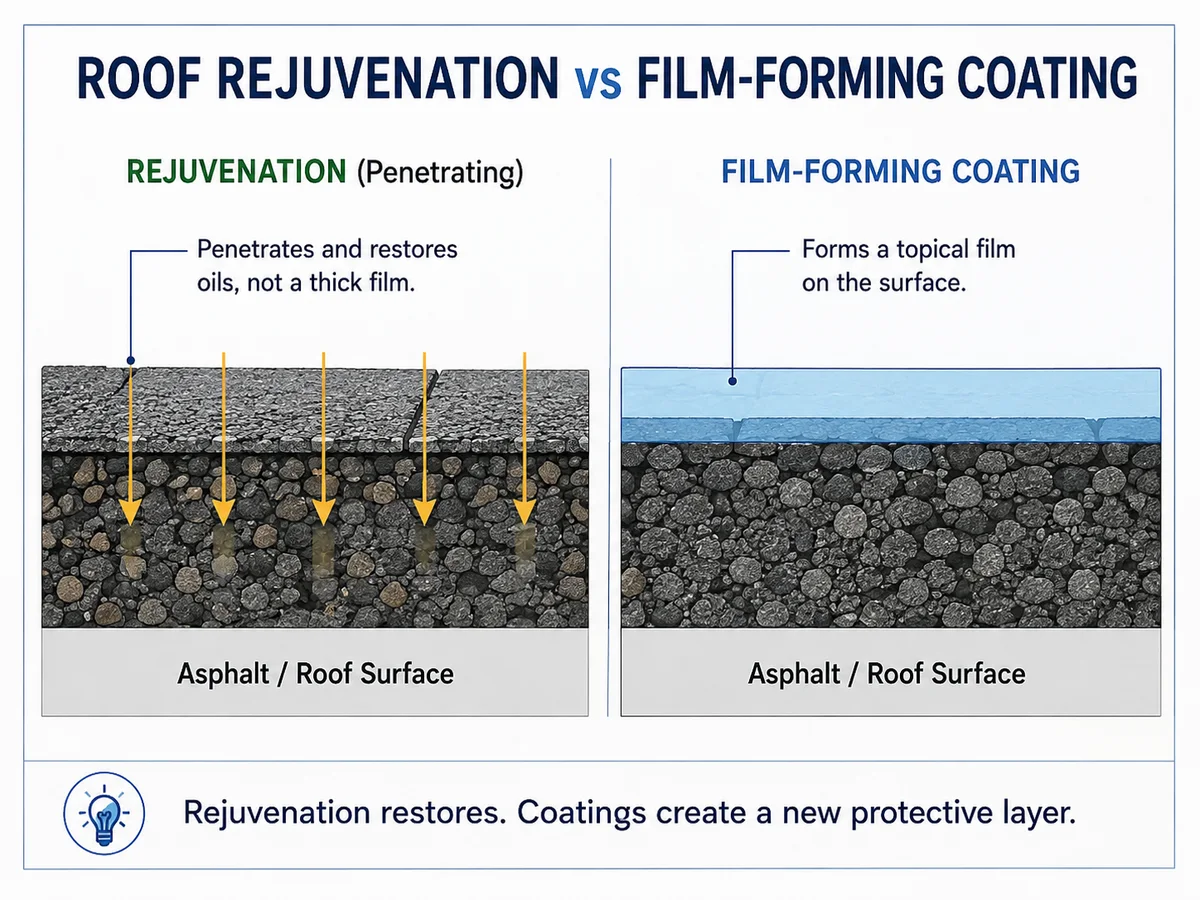
A roof rejuvenator and a roof coating may both be sprayed or rolled onto an existing roof, but they are not doing the same job. A rejuvenator is intended to penetrate asphalt shingles and alter the aged asphalt binder. A conventional roof coating forms a film or membrane over the roof surface.
The Difference in One Table
| Question | Shingle rejuvenator | Roof coating |
|---|---|---|
| Primary action | Penetrates qualifying asphalt shingles | Forms a surface film or membrane |
| Typical substrate | Asphalt shingles | Low-slope roofs, metal, modified bitumen, spray foam and other manufacturer-approved substrates |
| Main goal | Improve aging-shingle properties such as flexibility and granule retention | Weatherproofing, reflectivity, UV protection, restoration or maintenance depending on the system |
| Does it become a new roof covering? | No | Sometimes a liquid-applied system can be a roof-covering system; a maintenance coating is not automatically one |
| Repairs flashing or rotten decking? | No | No; defects normally require separate repair |
| Common homeowner confusion | Assuming it “replaces” old shingles | Assuming any white or elastomeric coating is a complete roofing system |
What a Shingle Rejuvenator Is Trying to Do
As asphalt shingles age, oxidation changes the asphalt binder and the shingle can become less flexible. Rejuvenator manufacturers use bio-based oils or related chemistry intended to penetrate the asphalt and restore some of the properties lost with aging. Laboratory reports on products such as Roof Maxx and Roof Rejuvenate have measured changes in properties including flexibility and granule retention after treatment.
The treatment is therefore better thought of as shingle conditioning or preservation than as a new roof surface.
What a Conventional Roof Coating Is Trying to Do
Acrylic, silicone, urethane, elastomeric, and other roof coatings generally remain on the exposed roof surface. Depending on the manufacturer and complete system, they may provide reflectivity, UV protection, waterproofing, or restoration of an appropriate existing roof assembly.
The word coating is not enough to tell you what is being installed. A thin maintenance coating and a reinforced liquid-applied roofing membrane are not automatically equivalent. Product approval, reinforcement, dry-film thickness, substrate preparation, repairs, primers, flashings, and application rate can all determine what the finished system actually is.
Why Asphalt Shingles Are a Special Case
Asphalt shingles are designed as overlapping individual units. Their granule surface, factory sealant strips, fastening pattern, ventilation conditions, and ability to drain water as a shingle assembly are part of how the roof functions. Applying a generic film-forming coating over shingles raises different compatibility and performance questions than coating a low-slope membrane or metal roof.
That is why a product marketed specifically as a penetrating shingle rejuvenator should not be casually grouped with silicone or acrylic roof coatings. The product category, substrate, test data, and warranty need to match what is actually being sold.
Florida Code and Insurance Context
Florida’s roofing rules make the distinction especially important. Some liquid-applied roofing systems fall within Florida Product Approval categories and may be evaluated as roofing systems. A maintenance treatment applied over an existing roof does not automatically become a replacement roof covering.
Citizens Property Insurance specifically says maintenance coatings and sealants—including acrylic, silicone, urethane, soy, elastomeric and similar materials—do not count as proof of roof-covering replacement. The age and condition of the underlying roof remain relevant.
The Buying Question to Ask
If a salesperson says a product will “restore,” “seal,” “rejuvenate,” “waterproof,” or “extend” a roof, ask which category it actually belongs to. Then ask for the exact product name, technical data, application specification, testing, written warranty, and explanation of what roof defects must be repaired separately.
The words may sound similar in an advertisement. The systems are not interchangeable.