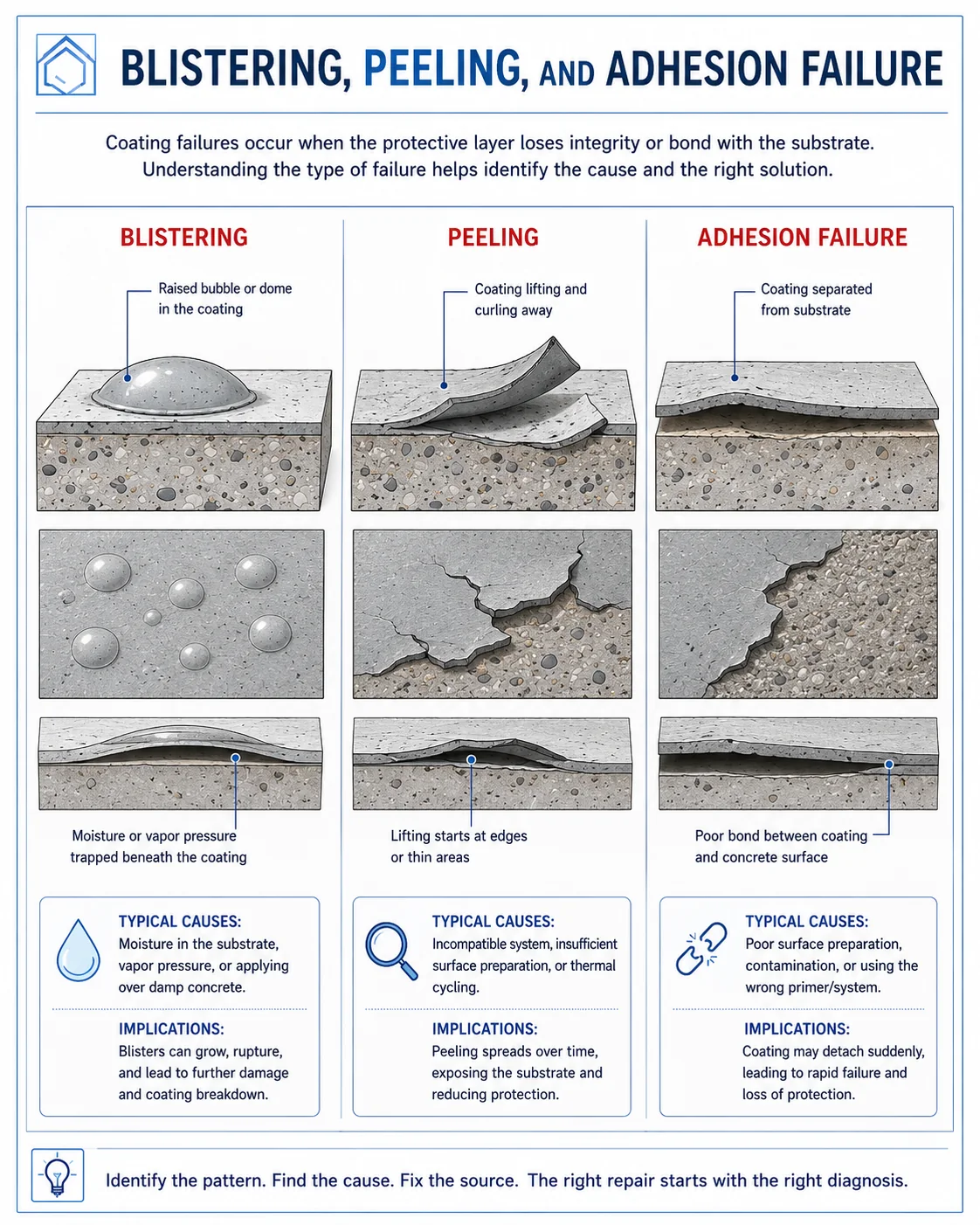
A failing roof coating is usually evidence, not a diagnosis. Peeling may mean poor adhesion, but the weak layer can be the new coating, an older coating underneath, the roof membrane itself, rust, dirt, chalk or wet/damaged material. Blisters can involve trapped moisture or movement. Cracks can follow seams and details that were never repaired. The correct repair starts by finding the failure plane before adding another coat.
Do Not Recoat a Failure Until You Know What Failed
If the existing coating is releasing from the roof, a new coating bonded to that failed layer can peel off with it. Loose material, wet insulation, blisters, incompatible old coatings, rust, open seams and deteriorated roofing need to be addressed first. A small test patch or adhesion test is often more useful than arguing about whether acrylic or silicone is “better.”
What Different Failure Patterns Can Suggest
| What you see | Possible causes to investigate |
|---|---|
| Large sheets peeling or lifting | Weak or contaminated substrate, incompatible old coating, inadequate cleaning/primer, moisture, or an older layer failing underneath. |
| Small blisters or bubbles | Moisture or vapor pressure, trapped solvent/water, coating over damp material, existing membrane blistering, or local adhesion loss. |
| Cracks over seams or penetrations | Movement at details, inadequate reinforcement/sealant, failed flashing, or field coating being used where a repair/detail system was required. |
| Pinholes / thin spots | Insufficient film thickness, rough substrate peaks, uneven application, porosity, or material applied below the specified coverage rate. |
| Rust bleeding through a metal roof coating | Active corrosion not adequately removed/treated, insufficient primer, failed fasteners, or water entering around seams and penetrations. |
| Softening or degradation in ponded areas | Product not intended for sustained ponding, contaminated water, weak underlying material, or drainage/structural low spots that were never addressed. |
Failure Cause 1: The New Coating Never Had a Sound Surface
Roof restoration manufacturers routinely require cleaning, repairs and adhesion verification because the new product can only stay attached as well as the layer underneath it allows. Dirt, oils, biological growth, loose granules, chalk, oxidation, old incompatible coatings and weathered membrane surfaces can all create a weak boundary layer.
This is particularly important on previously coated roofs. The surface might be silicone, acrylic, aluminum coating or an unknown older product. The correct primer and preparation can change depending on that history. See Is Your Existing Roof Coating Acrylic or Silicone?.
Failure Cause 2: Wet or Deteriorated Roofing Was Left Underneath
A coating can make the top surface look continuous without making wet insulation or damaged membrane disappear. Henry restoration specifications call for damaged, blistered or wet areas to be corrected before coating. In a Florida Henry project, moisture surveying was used to locate wet areas for removal before the new silicone system was installed. Gaco case studies likewise describe investigating blisters and replacing wet material rather than simply coating over the symptoms.
Failure Cause 3: Details Failed Even Though the Field Coating Looks Fine
Many roof leaks originate at penetrations, seams, flashings, drains, fasteners, curbs and transitions. Professional restoration specifications commonly use separate sealants, reinforcement or base coats at these areas before the field coating. If a contractor simply rolls the same white coating across everything, the roof may have a uniform color without a complete detail system.
Failure Cause 4: Not Enough Material Was Applied
Roof coatings have specified coverage rates and target film thicknesses. A thin application can leave rough-surface peaks, pinholes and weak areas with less weathering reserve. Compare the roof area with the number of pails used and the manufacturer’s specified gallons per square. Wet-film gauges can provide field checks during installation.
Failure Cause 5: Weather and Cure Conditions Were Wrong
Florida summer application windows can be unforgiving. A water-based coating applied before rain, heavy dew or adequate drying can behave very differently from one installed under its specified conditions. High substrate temperatures can also shorten working time. The exact product data sheet controls; “it was sunny when we started” is not enough.
Failure Cause 6: Ponding Water Exposed a System Limitation
Some silicone systems are specifically marketed and warranted for permanent ponding water, while many acrylic products have more restrictive ponding limitations. Even when the topcoat tolerates standing water, ponding can still signal blocked drainage, low spots, deflection or saturated roofing underneath. The question is both “Can this coating tolerate ponding?” and “Why is the water staying there?”
Can a Failing Roof Coating Be Repaired?
Sometimes. Localized failure over otherwise dry, sound roofing may be repairable after the defective material is removed back to a stable edge and the repair system is made compatible with the surrounding coating. Widespread delamination, extensive wet insulation, failing membrane, structural movement or a roof that cannot pass adhesion testing can make another coating cycle poor value.
- Localized: map the defect, remove loose material, investigate the substrate, perform specified repair and tie into sound coating.
- Repeated in many areas: stop spot-patching and determine whether there is a common substrate/compatibility/moisture problem.
- Widespread: consider whether coating removal, membrane repair/re-cover, or replacement is more rational than continuing to build on weak layers.
Questions to Ask Before Paying for Another Coat
- Where is the failure plane—new coating, old coating, membrane, rust, or substrate?
- How was moisture below the coating checked?
- What adhesion test will be performed on the remaining coating?
- What old material will be removed instead of buried?
- What primer or tie-coat is specified for the existing material?
- How are seams, penetrations, drains and fasteners repaired separately from the field coat?
- What finished film thickness and gallons-per-square rate are required?
- Will the repair qualify for a manufacturer/system warranty?
Sources
- Henry — Roof Restoration Guide Specification
- Henry — Florida Project Profile: Moisture Survey and Adhesion Test
- Gaco — Cape Canaveral Florida Roof Restoration Case Study
- GacoFlex S42 — Current Product Guidance and Adhesion-Test Requirement
- Gaco — Adhesion Test Procedure
What a Failing Roof Coating Can Look Like
Homeowners often describe a failing roof coating as peeling, chipping, blistering, cracking, ridging, bubbling or simply “deteriorating.” Those words are useful starting points, but they do not all describe the same failure. In some cases the coating itself is failing. In others, the coating is still attached to a roof membrane or older coating that is moving or releasing underneath it.
| What you see | What to investigate |
|---|---|
| Peeling, flaking or “chipping” | Where the separation occurs: new coating from old coating, old coating from membrane, corrosion, chalk, dirt, incompatible material, or wet/deteriorated roofing underneath. |
| Blisters or bubbles | Moisture, trapped air or solvent/water, loss of adhesion, or blistering in the roof membrane below the coating. |
| Ridges, wrinkles or buckles | Whether the raised area is actually in the membrane or roofing assembly rather than in the coating film itself. Movement below the coating can telegraph through the surface. |
| Cracking or splitting | Movement, aged or brittle material, failed seams/details, inadequate reinforcement, or coating stretched across a defect that needed a separate repair. |
| Pinholes, thin areas or exposed texture | Insufficient film thickness, rough substrate, porosity, missed coverage, or material spread farther than the specified coverage rate. |
| Leaks or wet spots below | Seams, penetrations, flashing, drains, fasteners, membrane defects, wet insulation and other roof-system details—not only the field coating. |
Roof Coating Ridging Is Not Always a Coating Defect
A ridge or wrinkle visible through a coated roof can originate in the roof membrane below the coating. IKO’s commercial-roof repair guidance, for example, discusses ridges, buckles and wrinkles in modified-bitumen membranes as movement-related conditions. Minor ridging may be monitored, while exposed or deteriorating ridges can eventually crack and admit moisture.
That distinction matters because simply applying more liquid coating over a moving ridge does not correct the movement underneath. The raised area needs to be identified first: coating build-up, a membrane wrinkle, a blister, a seam, or a previous repair can require different treatment.
“Chipping” Usually Means Find the Failure Plane
Elastomeric roof coatings do not always fail in hard paint-like chips, so a homeowner describing “chipping” may actually be seeing flaking, peeling, erosion, or pieces of an older coating or roofing surface coming loose. The useful question is: what material is attached to the underside of the loose piece?
If the loose material exposes a clean old coating, the new coat may have lost adhesion. If several coating layers come off together, the weak bond may be lower in the system. If roofing granules, oxidized metal, wet membrane or deteriorated substrate come away with the coating, recoating alone is unlikely to solve the underlying problem.
How a Failing Roof Coating Should Be Investigated
- Map the failure. Note whether defects are isolated, concentrated around details, limited to ponding areas, or spread across the whole roof.
- Identify the roof and old coating. Acrylic, silicone, asphaltic coatings, metal-roof systems and membrane roofs can require different preparation and primers.
- Find the failure plane. Determine which layer is actually separating.
- Check for moisture. Blistering or repeated failure may justify moisture investigation rather than another surface coat.
- Inspect seams and penetrations separately. Curbs, drains, pipes, fasteners, flashings and transitions commonly need their own repair details.
- Perform the manufacturer-required adhesion test. A test patch on a representative prepared area can show whether the remaining surface is a viable substrate.
- Compare actual coating usage with the specification. Gallons used and film-thickness checks can reveal whether the coating was applied too thinly.
- Decide whether the failure is local or systemic. A few sound repair areas are a different project from widespread delamination or wet roofing.
Can a Failed Roof Coating Cause Leaks?
It can contribute to loss of weather protection, but a leak should not automatically be blamed on the visible coating defect. Water can enter through seams, penetrations, flashings, drains, fasteners, membrane splits or other roof details and travel before it becomes visible inside the building.
Gaco’s published Cape Canaveral restoration case is a useful example: a blistering asphalt roof was investigated for moisture, and wet material was removed and replaced before the silicone restoration system was installed. The visible surface problem was not treated as a reason to simply roll another coat over the roof.
Repair, Recoat, or Stop and Reassess?
Localized repair can make sense when the surrounding roof is dry and sound, the failure plane is understood, loose material can be removed to a stable edge, and the repair can be made compatible with the existing system.
A broader recoat may make sense when the existing roof remains a sound substrate, adhesion testing is acceptable, details are repaired first, and the new coating system is compatible with what remains.
Stop and reassess when failure is widespread, moisture is present in the roof assembly, the membrane itself is deteriorating, ridges or movement are substantial, or repeated spot repairs keep failing. At that point, another coat can become an expensive way to postpone a roof-system decision.
Manufacturer guidance controls the actual repair method. Roof-coating systems vary in substrate limits, primers, adhesion-testing procedures, film thickness, ponding-water requirements and repair details.