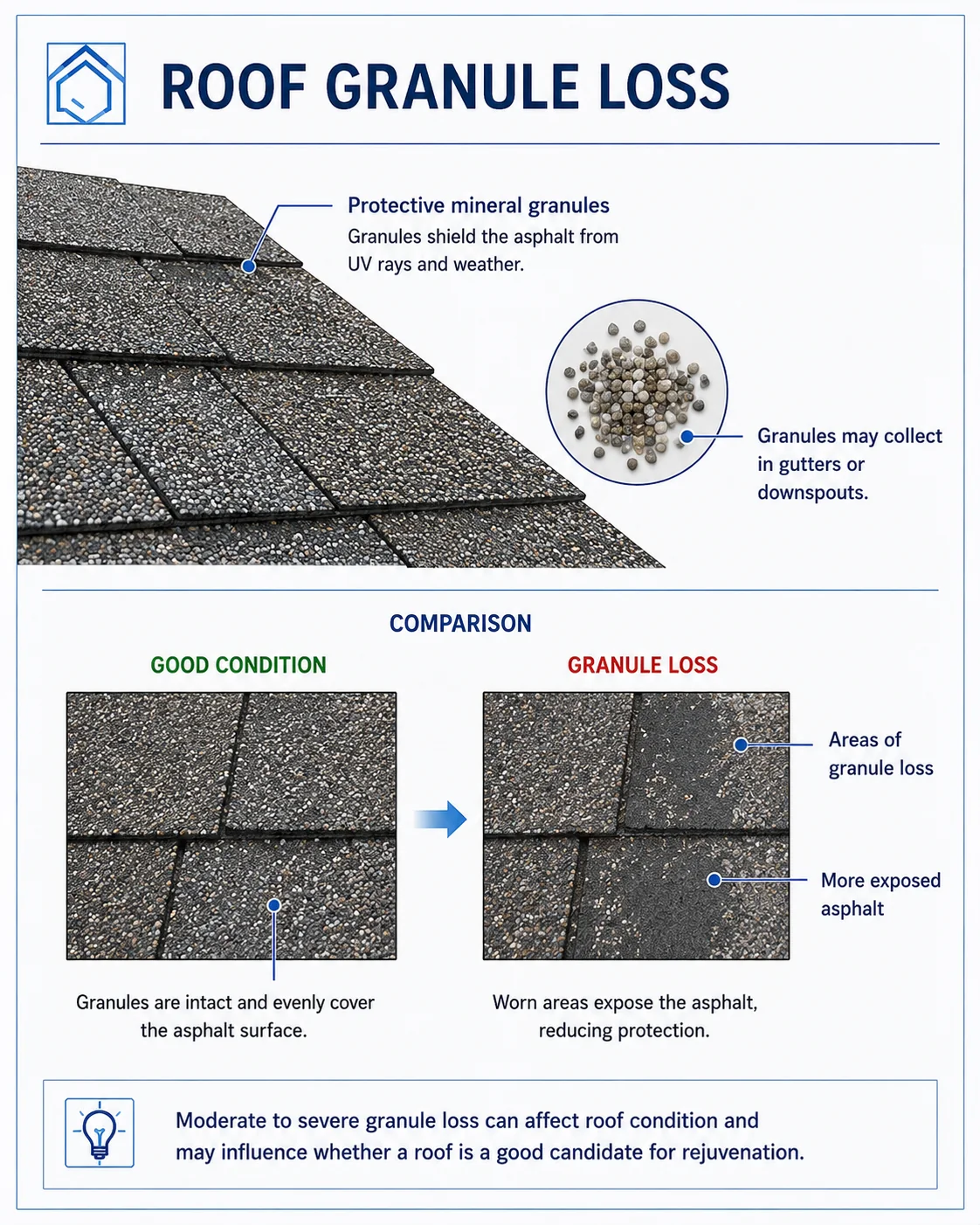
“86% better granule adhesion” is one of the most repeated statistics in shingle-rejuvenation marketing. The number traces to a specific laboratory comparison, not a universal finding that every rejuvenator makes every roof 86% better. Current Roof Rejuvenate testing, for example, publishes a different result: 53% less granule loss in its 2025 comparison.
Where the 86% Number Comes From
A 2018 screening evaluation of a product marketed as RoofRestor compared granule loss from untreated and treated aged shingles. Published summaries report 1.11 grams of granule loss for the untreated sample and 0.15 grams after treatment. The difference was characterized as an 86% improvement in granule adhesion.
That is a legitimate way to describe the percentage change in that particular test. It should not be rewritten as “the shingles have 86% granule adhesion,” because the test measured relative granule loss, not an absolute percentage of all granules remaining attached to a roof.
Why Wording Matters
There is a large difference between these statements:
- “This laboratory sample lost 86% fewer granules after treatment than the untreated comparison.”
- “Rejuvenated shingles have 86% granular adhesion.”
The first statement describes a comparative test result. The second sounds like an absolute property of the roof and leaves the test context unclear.
Current Roof Rejuvenate Testing Uses a Different Number
Roof Rejuvenate’s current 2025 testing summary says untreated shingles lost 1.43 grams of granules while treated samples lost 0.67 grams after accelerated weathering. The company reports that as 53% less granule loss.
That does not contradict the older 86% result because the product, formulation, shingle samples, aging protocol, and test conditions may differ. It does show why an old percentage should not automatically be carried forward into marketing for a current product.
Does Better Granule Retention Mean Longer Roof Life?
Granules protect the asphalt surface from ultraviolet exposure and contribute to the shingle’s durability and appearance, so reducing granule loss is potentially useful. But a complete roof can fail for reasons unrelated to granule adhesion, including flashing defects, missing shingles, nail problems, failed penetrations, deck damage, storm damage, or installation errors.
A granule-retention test therefore supports a claim about granule retention. Turning that percentage directly into a number of additional roof years requires additional evidence.
How Surface Blueprint Will Handle Percent Claims
- Name the exact product tested.
- Identify whether the document is a complete lab report, a manufacturer summary, or a dealer marketing page.
- State what was actually measured.
- Give the untreated and treated numbers when available.
- Do not convert a laboratory property improvement into a lifespan percentage without evidence connecting the two.
- Do not assume an older test applies to a later formulation.
Bottom Line
The 86% figure is not meaningless, but it is easy to oversimplify. It describes a large reduction in granule loss in a particular published test. Current Roof Rejuvenate literature cites a different 53% granule-loss result from newer testing. Both numbers are more useful when presented with their test context than when used as stand-alone proof that a roof will last a specific number of additional years.