Roof rejuvenation is not the same thing as coating a roof. A shingle rejuvenator is designed to penetrate aging asphalt shingles and change properties such as flexibility and granule retention. That can be a legitimate maintenance concept, but it does not repair bad flashing, rotten decking, missing shingles, failed penetrations, or every other reason a roof leaks.
Start here for the general subject. This guide explains what roof rejuvenation is, what the evidence can and cannot prove, which roofs may qualify, and how treatment differs from coating or replacement. If you already understand the concept and are deciding whether the economics make sense, see Is Roof Rejuvenation Worth It?
The Short Version
- Shingle rejuvenators are penetrating treatments, not replacement roof coverings.
- Laboratory testing shows that some products can improve measurable properties of aged shingles. Those tests are meaningful, but they are not the same as proving that every treated roof will last another 5, 10, or 15 years in service.
- A roof has to be a good candidate before treatment. A rejuvenator does not correct structural deterioration, defective flashing, missing shingles, widespread delamination, rotten sheathing, or installation defects.
- Florida insurance treatment is a separate question from physical roof performance. A rejuvenation treatment does not reset the roof’s installation date or automatically count as a roof replacement.
- The best buying decision starts with diagnosis. Find out what condition the roof is actually in, what the warranty covers, what testing supports the product claims, and how your insurer will treat the roof after application.
What Is Roof Rejuvenation?
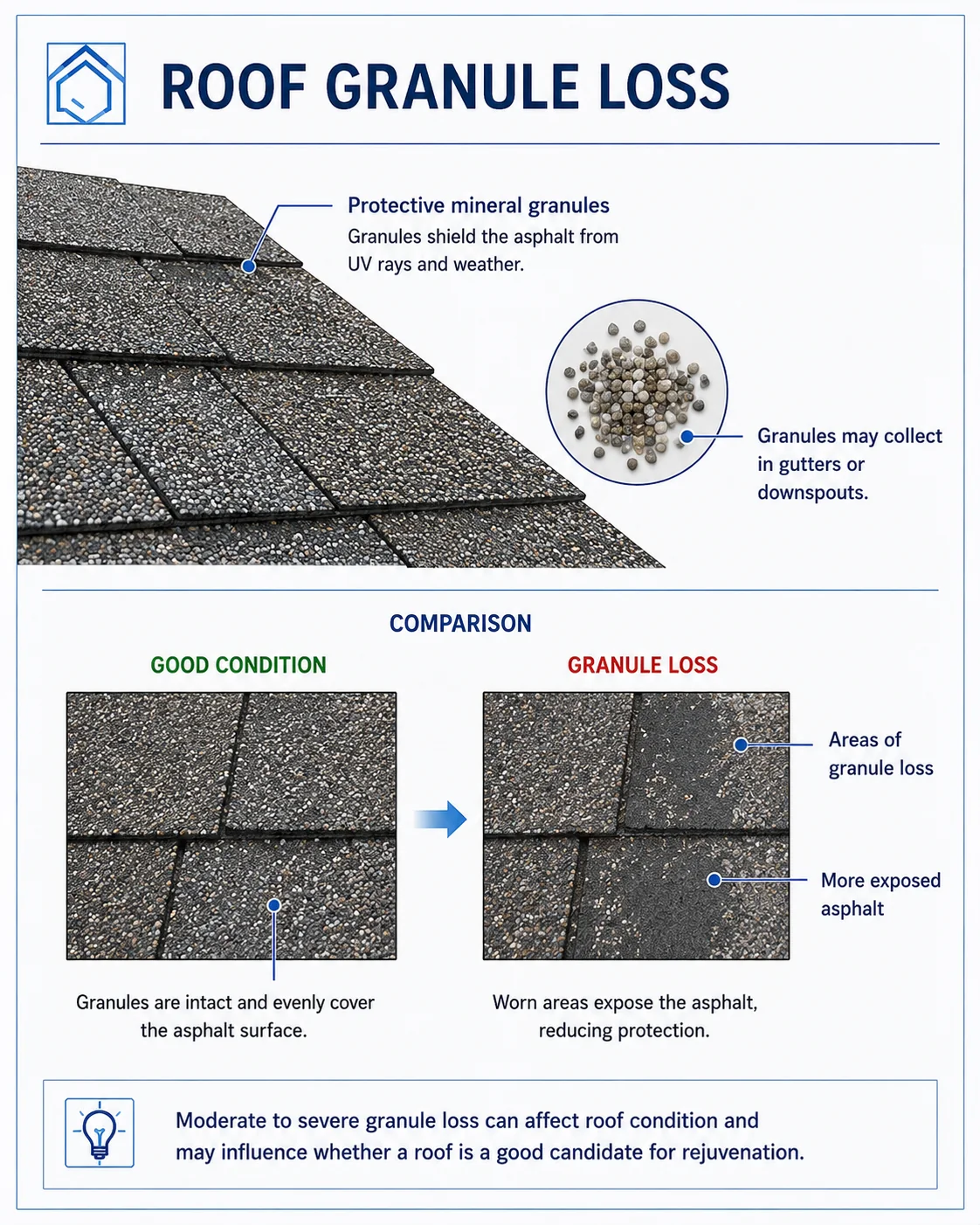
Asphalt shingles age as their asphalt binder oxidizes and changes over time. The shingles may become less flexible, and granules can become easier to dislodge. Shingle rejuvenation products are marketed as a way to slow or partially reverse some of those changes by introducing compatible bio-based oils or other rejuvenating chemistry into the asphalt portion of the shingle.
This is fundamentally different from applying a silicone, acrylic, urethane, or elastomeric coating over the top of a roof. A conventional coating forms a surface film or membrane. A rejuvenator is intended to penetrate the shingle rather than encapsulate it.
What Laboratory Testing Actually Shows
The general concept is not unsupported. An Ohio State University technical report on Roof Maxx, a soy-methyl-ester-based rejuvenator, evaluated treated and untreated aged shingles using ASTM-related testing. The report found improvements in characteristics including flexibility, granule adhesion, and permeability, and concluded that the treatment showed potential to extend roof service life. The report also disclosed that the work was prepared at the request of Roof Maxx Technologies and the Ohio Soybean Council as part of an Ohio Soybean Council-funded project.
A newer Roof Rejuvenate testing summary says PRI Asphalt Technologies compared untreated 15-year-old shingles with shingles treated using its current corn-based product during 1,500 hours of accelerated weathering. The published summary reports 53% less granule loss, a 66.7% improvement in cold-weather pliability, and higher tear strength in one direction for the treated samples.
Those results answer an important question: can treatment change measurable properties of an aged shingle? In the reported tests, yes. They do not by themselves answer a different question: will every treated Florida roof remain serviceable for another 5, 10, or 15 years? Actual roof life also depends on installation quality, flashing, penetrations, storm damage, ventilation, deck condition, previous repairs, shingle condition, exposure, and other variables outside the chemistry of the shingle itself.
What a Rejuvenator Cannot Fix
- Rotten or delaminated roof decking.
- Failed chimney, wall, valley, skylight, or edge flashing.
- Improperly installed flashing or underlayment.
- Missing or badly torn shingles.
- Widespread shingle curling, cracking, or physical breakup beyond the product’s candidate limits.
- Nail pops, fastening defects, or shingles that were improperly installed.
- Leaks caused by penetrations, vents, boots, transitions, or other roofing-system details unless those defects are separately repaired.
This is why some rejuvenation companies include or offer a roof tune-up before treatment. The distinction matters: repairs may correct roof-system defects, while the rejuvenator is intended to improve the condition of qualifying asphalt shingles.
Which Roofs Are Candidates?
Current Roof Rejuvenate guidance says shingles commonly begin showing signs that may make rejuvenation useful in roughly the five-to-ten-year range, while significant curling, granule loss, or other damage may disqualify a roof. Roof Maxx likewise describes treatment as most useful before the roof has progressed too far into failure.
That creates an important practical rule: a product sold as a way to postpone replacement should not be evaluated only after someone has already decided the roof needs replacement. The roof first needs an independent condition assessment. The more deteriorated the roof, the more important it is to distinguish a maintainable aging shingle from a roof system that has already failed.
Florida Insurance: Physical Life and Insurance Life Are Not the Same Thing
Florida law gives homeowners an important protection when roof age is the issue. For a roof that is at least 15 years old, an insurer must allow an inspection before requiring replacement as a condition of issuing or renewing a homeowners policy. If an authorized inspection says the roof has at least five years of useful life remaining, the insurer may not refuse to issue or renew solely because of roof age.
That does not mean Florida law declares a rejuvenated roof to be a new roof. Florida’s roof-age calculation is tied to when the roof surface was built or replaced. Citizens Property Insurance also states that acrylic, silicone, urethane, soy, elastomeric, and similar coatings or sealants do not constitute proof of roof replacement. Citizens evaluates age and condition after treatment rather than resetting the roof’s age.
For a Florida homeowner, this means a rejuvenation proposal should answer two separate questions: Will this treatment improve the physical condition of my shingles? and What documentation will my insurer require after the work?
Before You Buy: Ask These Questions
- Who inspected the roof, and is that person independent of the sale?
- What specific conditions make this roof a good candidate?
- What defects will be repaired before treatment?
- What exact rejuvenation product will be applied?
- Can I see the current technical data and current written warranty?
- Does the warranty cover leaks, granule loss, flexibility, retreatment, labor, or only a narrower performance characteristic?
- Is the remedy a refund, repair, or prorated retreatment?
- Does the company claim 5, 10, or 15 additional years, and what field evidence supports that duration?
- Will my current insurer accept the proposed inspection or roof-life certification?
- Will the treatment affect any remaining shingle-manufacturer warranty?
Surface Blueprint Bottom Line
Roof rejuvenation should not be dismissed simply because it sounds unusual. Published testing shows that at least some rejuvenators can improve measurable properties of aged asphalt shingles. But the strongest laboratory result is still not a substitute for diagnosing the whole roof. A rejuvenator can only act on the shingles it reaches; it cannot correct every failure mode in the roofing system.
The useful buying question is therefore not “Does roof rejuvenation work?” in the abstract. It is: Is this particular roof still structurally and functionally sound enough that improving the condition of its shingles is likely to be worth the cost?